
Every parent has opened a lunchbox at four in the afternoon and found it almost exactly as it was packed. The vegetables untouched, the roti dry, the fruit browning quietly in its corner. And the child, of course, is starving.
It is easy to read this as fussiness. Usually it is something more practical: a lunchbox designed for a nutrition chart rather than for the thirty minutes, the temperature and the social conditions in which a child actually eats.
Start with the clock, not the food pyramid
The single most useful thing a parent can do is find out when their child eats, and pack for those windows specifically.
At our Ballari campus, the day runs from 9:00 AM to 3:30 PM, with a short break from 10:30 to 10:45 AM and lunch from 12:45 to 1:15 PM. At CV Raman Nagar the day starts earlier — 8:15 AM — with the short break from 10:35 to 10:45 AM and lunch from 12:30 to 1:00 PM. Timings vary by campus and grade, so it is worth confirming your child's.
Read those numbers as a design brief. The short break is ten to fifteen minutes — enough for something eaten with one hand, standing, while talking. Lunch is thirty minutes, of which a realistic fifteen to twenty are spent actually eating once washing hands and settling are accounted for. Nothing that requires assembly, peeling, patience or a fork-and-knife will be finished.
The gap between an 8:15 start and a 12:30 lunch is also long. A child who ate breakfast at 6:30 has gone six hours by lunchtime. The mid-morning snack is not optional in that arithmetic — it is what carries them through the most academically demanding part of the day.
The mid-morning break: small, fast, one hand
Fruits and nuts make excellent morning-break snacks, and they work precisely because they need no preparation. The rules that matter here are practical: nothing that needs peeling by the child, nothing that leaks, nothing that has to be shared out of a large container.
Sliced apple with a squeeze of lemon, a small banana, grapes off the stem, a handful of almonds or roasted chana, a few dates, cubes of cheese. A boiled egg. Roasted makhana. These get eaten because they can be.
What does not get eaten in ten minutes: a whole pomegranate, a fruit salad that has gone watery, anything requiring a spoon and a flat surface.
Lunch: build it around what survives four hours in a bag
Lunch has a harder job. It has to still be appetising after four hours at room temperature, in a bag, in Karnataka.
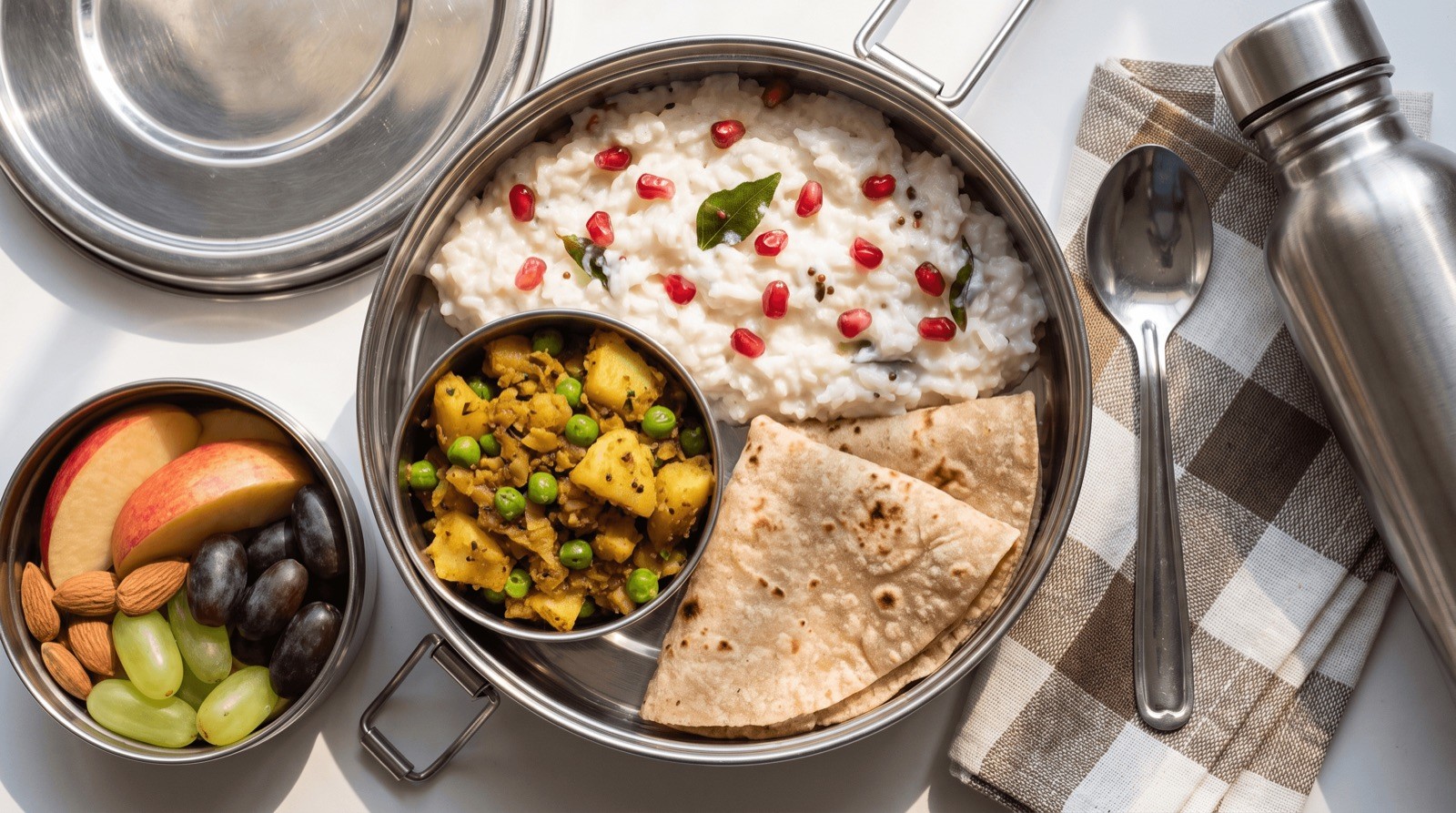
The combinations that hold up share a structure — something starchy, something with protein, something with moisture so the whole thing does not turn to cardboard, and something that adds interest. Curd rice travels beautifully and is genuinely cooling. Lemon rice, pulao and tamarind rice hold their texture. Roti with a thick dry sabzi works if the roti is spread lightly with ghee, which is the difference between soft and brittle by 12:45. Idlis with a small pot of podi and ghee, dosa rolled around a filling, paratha with a thick raita — all of these are eaten more often than they come back.
Two additions do most of the work. A little extra moisture — a spoon of ghee, a thicker gravy, a small separate pot of curd — prevents the dryness that makes food unappealing. And one small element the child genuinely likes, packed alongside rather than instead of the rest, changes the odds considerably.
Send a labelled napkin, spoon and water bottle daily. It sounds obvious and it is the most common reason a child eats less than they meant to.
The afternoon slump is often a lunchbox problem
Teachers see it clearly — the class that is sharp at eleven and vague at two. Some of that is simply the rhythm of a long day. A good deal of it is what was, or was not, eaten at 12:45.
A lunch that is almost entirely refined carbohydrate — white rice alone, plain bread, biscuits — produces a fast rise and an equally fast fall, and the fall lands in the middle of the afternoon. Adding protein and some fat to the same meal flattens that curve considerably. Curd, dal, egg, paneer, chana, a spoon of ghee, nuts in the morning snack: none of it is exotic, and together it is the difference between a child who is present after lunch and one who is waiting for the bell.
Sugary drinks and packaged snacks do the same thing more sharply. We encourage healthy options generally — including for birthday celebrations, where fruits, dry fruits or jaggery-based sweets are welcome in place of sugary items, and where families often choose instead to donate a book to the library or a plant to the campus in their child's name.
Habits worth building alongside
We encourage children to follow basic table manners at school, and these hold much better when they are reinforced at home. Eating with a spoon rather than hands where appropriate, not wasting food, clearing one's own place — small things, learned early, that stop being instructions and become simply how one eats.
One more, easily overlooked: we are an eco-conscious school and ask families to avoid single-use plastics in lunch boxes — disposable spoons, straws and covers. A steel box, a steel spoon and a refillable bottle solve it permanently and outlast several school years.
And if food does need to be sent later in the day, please hand it over at the security desk clearly labelled with your child's name, class and section.
Frequently asked questions
My child brings the lunchbox back full. What should I change first?
Change quantity before you change food. A box that looks impossible is often not started at all, and a child who finishes a small lunch eats more than one who abandons a large one. After that, look at texture — dryness is the most common reason food is rejected — and only then at variety. It also helps to ask your child directly what happened; the answer is frequently something simple, like not having time, or the box being hard to open.
Is a mid-morning snack really necessary?
For most children, yes. With a school day starting at 8:15 or 9:00 and lunch not until 12:30 or 12:45, the gap from breakfast is long — and the short break exists precisely for this. Something small and quick is enough; it does not need to be a second meal.
What are good options for a child who refuses vegetables?
Work around the objection rather than through it. Vegetables grated into parathas, blended into a thick gravy, or cooked into pulao and lemon rice are accepted far more readily than the same vegetables served separately. Curd, dal, paneer and egg cover a great deal of nutritional ground in the meantime. Refusal at this age is common and usually temporary — pressure at the table tends to extend it rather than shorten it.
How do I keep food from spoiling by lunchtime?
Pack food that has cooled before the box is closed, since trapped steam is what accelerates spoiling. Favour dishes that are stable at room temperature — rice-based dishes, curd rice, dry sabzis — and keep anything with fresh coconut or a lot of raw onion for cooler days. An insulated box helps; so does keeping the bag out of direct sun.
What should I do about birthdays and treats?
Cakes, gifts and return gifts are not permitted in school, and birthdays are celebrated in a healthy and inclusive way. Fruits, dry fruits and jaggery-based sweets are welcome. Many families choose the alternative of donating a book to the library or a plant to the campus, labelled with their child's name — it lasts considerably longer than a cake and children tend to be rather proud of it.


